The question
Does a manufacturer’s operating stability depend mainly on its own digital transformation, or also on the practices of the partners it repeatedly buys from and sells to? Procurement, delivery, and inventory information cross firm boundaries. Looking only at the focal firm can therefore miss an upstream source of operating stability. This study separates three questions: whose digitalization is observed, what kind of digital routine is involved, and which dimension of resilience is measured.
Data and design
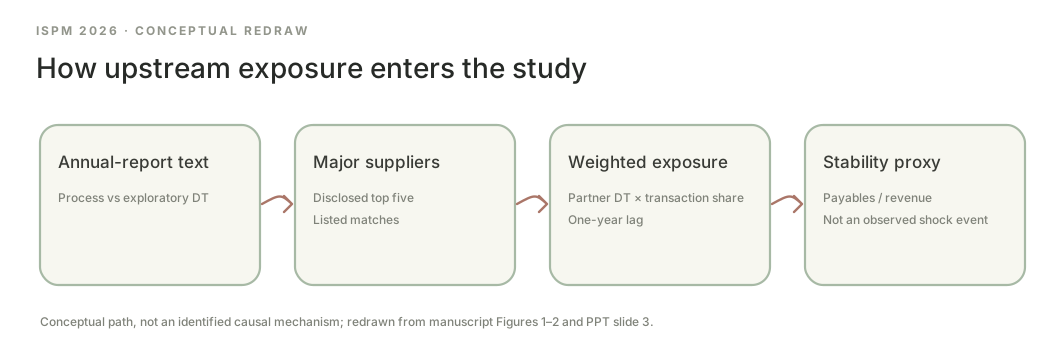
The authors examine Chinese A-share listed manufacturing firms from 2005 to 2024. They use the Management Discussion and Analysis sections of annual reports to measure two forms of digital transformation. Exploitative digitalization refers to process refinement, standardization, and automation; exploratory digitalization captures capability development and search for new applications. Disclosed top-five supplier and customer ties are then used to construct transaction-weighted exposure to matched listed partners’ digitalization. The core regressions contain 24,645 firm-year observations, include firm and year fixed effects and firm controls, and lag the explanatory variables by one year.
Which resilience is measured
The main outcome is a proxy for resistance-related operational stability, constructed from accounts payable relative to revenue. It reflects reliance on supplier financing in routine operations. It does not directly observe a shutdown, stockout, or a named disruption. A supplementary recovery proxy uses price-adjusted inventory turnover to capture operating adjustment. Maintaining continuity and recovering after disruption are distinct questions, so the two measures should not be treated as interchangeable.
What the estimates show
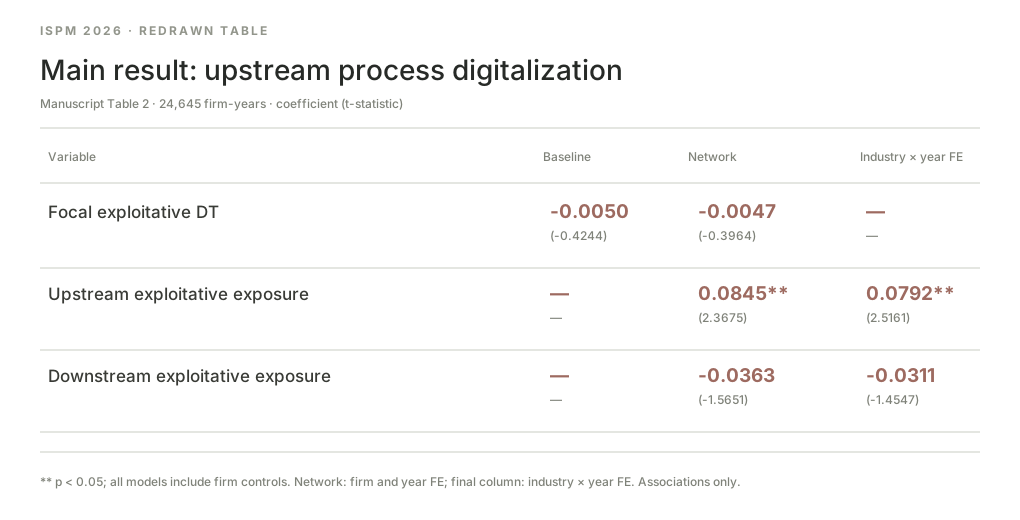
The clearest result is a positive association between major suppliers’ exploitative digital exposure and the focal firm’s resistance proxy. The network specification reports a coefficient of 0.0845. It remains positive with two-way clustered standard errors, and the estimate is 0.0792 after adding industry-by-year fixed effects. The authors translate a one-standard-deviation increase in this exposure into an outcome change of approximately 2.9% of the resistance proxy’s standard deviation. In the reported resistance models, neither the focal firm’s own exploitative digitalization nor downstream customer exploitative exposure shows comparably clear statistical evidence. Exploratory exposure on the recovery side is more sensitive to specification choices.
How to read the result
A plausible interpretation runs through procurement continuity: more orderly supplier records, order handling, and delivery routines may reduce uncertainty for the buying firm. The models, however, establish conditional associations, not a causal mechanism. The observable network is also limited to disclosed major partners that can be matched to listed firms. Private, foreign, unlisted, and more distant partners fall outside this measure.
Why it matters, and what comes next
The contribution is a more precise way to ask whether digitalization helps supply chains. Which firm adopted the routines? On which side of the relationship? Is the outcome ongoing operating stability or subsequent adjustment? The present evidence points most clearly to one upstream, process-oriented association. Fuller partner networks, observed disruption events, and stronger identification would be needed to determine when this path operates and whether it changes a firm’s capacity to withstand shocks.
About this article
This is a web edition of a paper published at the conference. Figures are taken from the conference paper (main regressions, N = 24,645); raw data are not provided on this site; the results are conditional associations and are not causal estimates.
Original title: Digital Spillovers in Major Buyer–Supplier Ties and Resistance-Related Operational Stability: Evidence from Chinese Manufacturing Firms. The 14th International Symposium on Project Management (ISPM 2026).